
Outbound vs Inbound for High-Ticket B2B Firms
Should high-ticket B2B firms focus on inbound or outbound? This article breaks down the strengths, limitations, and ideal role of both approaches.
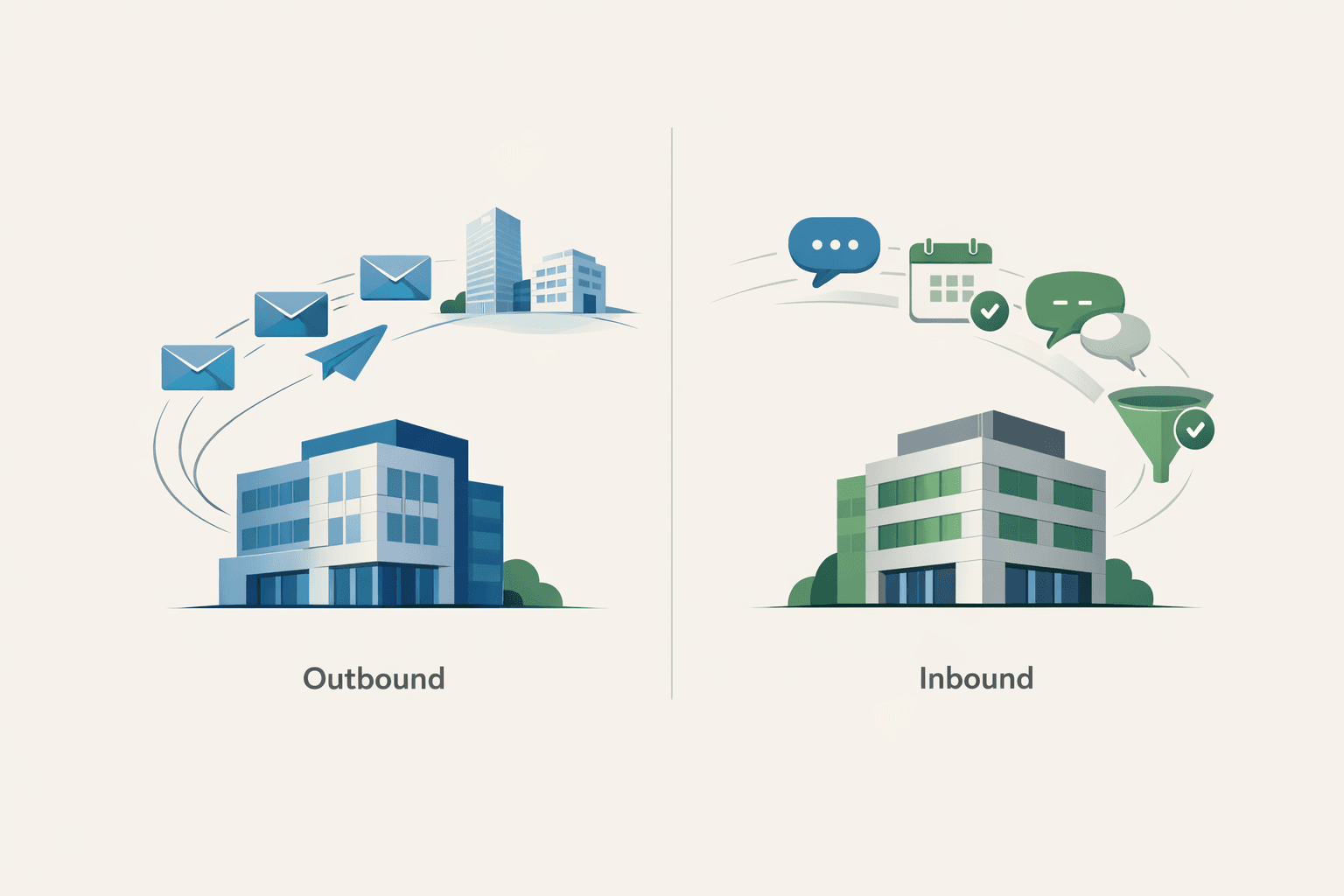
A lot of B2B firms frame inbound and outbound as competing strategies. In reality, they solve different commercial problems. The strongest high-ticket firms usually need both, but not in the same way and not for the same reason.
What inbound is good at
Inbound captures existing demand. It works well when the market already knows the problem, is actively searching for solutions, and is willing to consume content before speaking to a provider.
For high-ticket B2B firms, good inbound often means higher-intent conversations, lower friction in early sales stages, and a stronger credibility effect because the prospect arrives already somewhat educated.
Where inbound falls short
Inbound is not fully controllable in the short term. It takes time to build authority, time to rank, time to create visibility, and time for trust signals to compound.
That becomes a problem when the business needs pipeline now, wants to target specific accounts, or cannot afford long gaps between marketing investment and opportunity creation.
What outbound is good at
Outbound creates commercial motion where none exists yet. It allows a firm to define the segment it wants, reach the relevant decision-makers, and test market messaging much faster than waiting for search demand alone.
For high-ticket B2B firms, outbound is especially valuable when the offer solves a real business problem that buyers may not be actively searching to solve this week, but will still engage with if the message is relevant enough.
Where outbound fails
Outbound breaks down when targeting is broad, copy is generic, and follow-up is weak. In those cases, firms conclude that outbound “doesn’t work,” when in reality the system was poor.
Bad outbound creates noise. Good outbound creates relevance. The difference is usually ICP clarity, message quality, and execution discipline.
Which one is better for high-ticket B2B?
If the question is “Which channel should we rely on entirely?”, the answer is usually neither. High-ticket B2B firms tend to perform best when inbound and outbound play complementary roles.
Inbound builds trust, visibility, and long-term demand capture. Outbound creates targeted pipeline, faster testing cycles, and more control over who enters the funnel. Together, they make the commercial model more resilient.
How to decide what to prioritise
If the firm has very little pipeline visibility and needs conversations quickly, outbound usually deserves early priority. If the firm already has some commercial motion and wants to compound authority over time, inbound deserves steady investment alongside it.
A useful rule is this: inbound helps you be found; outbound helps you be chosen by the right prospects sooner.
Final takeaway
For most owner-led high-ticket B2B firms, this is not an either-or decision. It is a sequencing decision. Build enough outbound to create control. Build enough inbound to create credibility and compounding demand.
The wrong move is betting the whole pipeline on one channel and hoping the market cooperates.
If growth still relies on word of mouth, inconsistent outbound, or founder-led follow-up, we help owner-led B2B firms build the commercial system behind a more predictable pipeline — from outreach and follow-up to qualification and conversion.